My Work
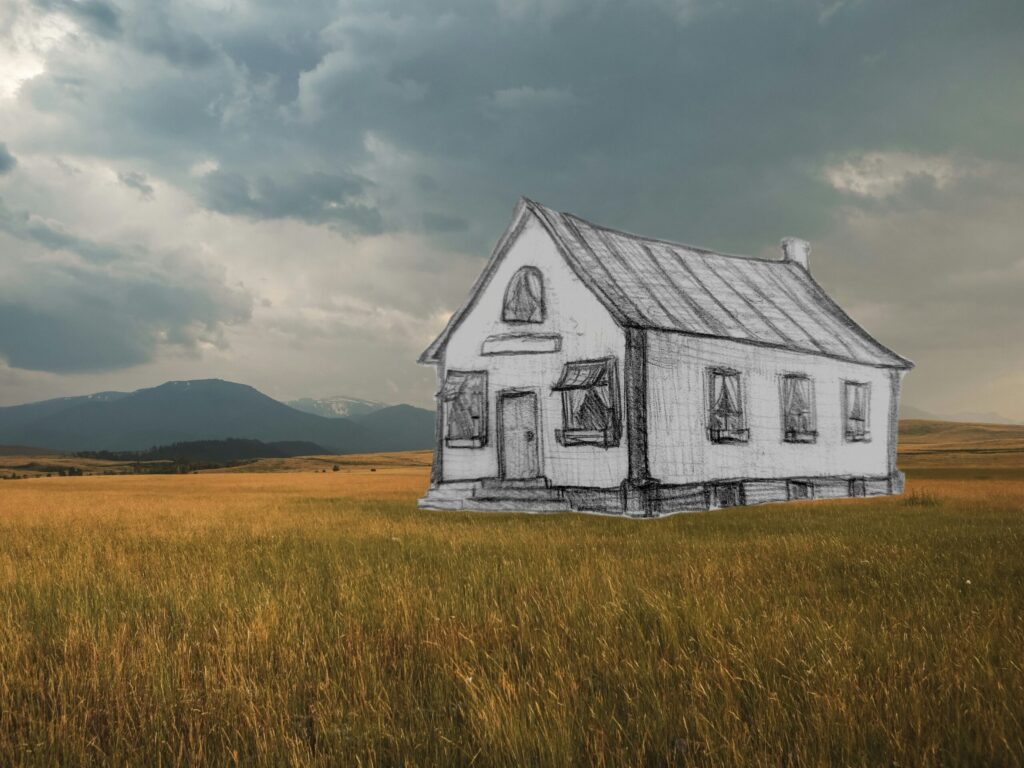
This is a pencil drawing of a two-point perspective house. It is inspired by old prairie houses that can be found in Saskatchewan. After finishing the drawing, I took a photo of it, uploaded it to Pixlr Express, and removed the space around it. Then, I replaced the background with a landscape photo of grass plains.
Stop and Think
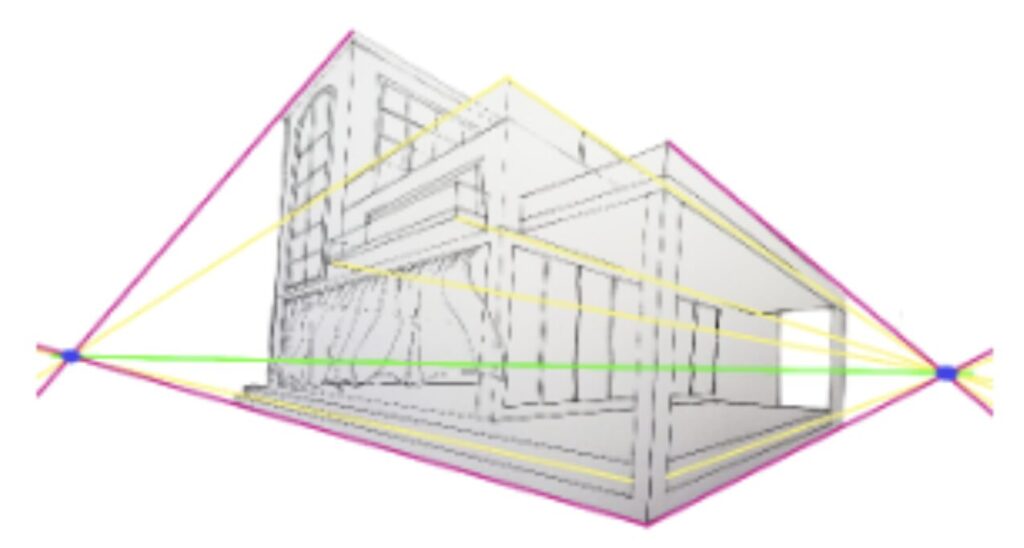
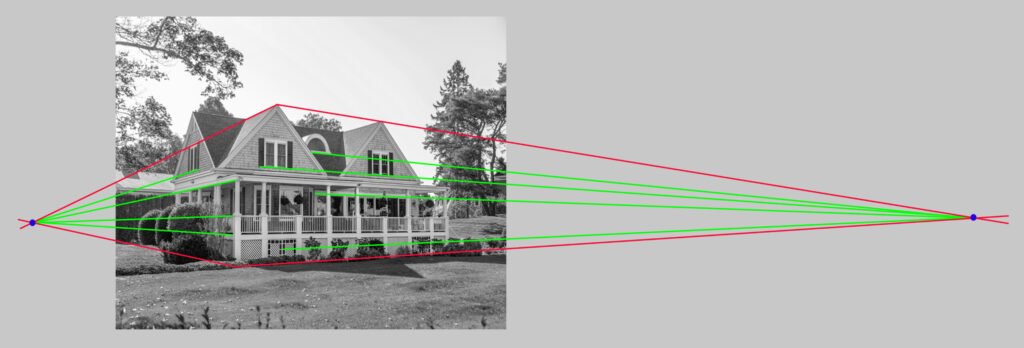
Find a picture of a building or cityscape online in two-point perspective. Print it out in black and white and identify the vanishing points with a coloured dot. Draw at least four guidelines to each vanishing point, using a ruler and going over them in a different colour of marker. You can also do this by using the line tool in Photoshop of Pixlr if you would prefer.
Artist Connection
Based on the architects you have learned about in this lesson, do you believe that architects are artists or not? Depend your stance in a short essay.
I believe that architects are artists. Both architects and artists use techniques such as two-point perspective to draw three-dimensional forms, showcasing different sides of their buildings and compositions. It takes creativity to come up with ideas and shapes that are aesthetically pleasing to the eye. Designing blueprints for buildings does not only rely on the left side of the brain (responsible for logic and mathematics), it also uses the right side of the brain (responsible for creativity and artistic expression). In this essay, I will discuss how architects are artists based on their use of proportion, form, and visual balance.
Architects work in Realism, which means their designs represent reality in a truthful and accurate way. Because their buildings will exist in the physical world, they must ensure their designs are both visually appealing and structurally sound. One important aspect of accuracy is proportion. It refers to the design principle concerned with the relationship between objects in terms of size, amount, number, and degree. Architects must consider how elements within their design interact with one another. For example, they need to determine the appropriate size of doors in relation to walls inside buildings.
Another important aspect of architectural accuracy is form. Architects must think in three dimensions, designing structures that can exist in reality. Because their designs will transform from an idea to a real thing, they need to effectively represent their ideas using two-dimensional drawings. This is achieved through perspective, a method that allows architects to show depth in their drawings.
Lastly, architects must consider visual balance. Similar to artists, they create balance within their designs by manipulating formal elements, positioning structures, and taking note of visual weight. Architects do not only focus on balancing the components within a building, but they also take note of the relationship between their structure and its surroundings. This includes integrating their work with nature, existing permanent structures, and other nearby buildings to create a well-balanced environment.
In conclusion, architects approach design with the same artistic mindset as traditional artists. That is because they carefully consider proportion, form, and visual balance in their drawings and creations. Their ability to transform creative ideas into something real shows the deep connection between architectural design and artistic expression. Just like artists, architects can creatively shape the world around us.
Source: Visual Arts 20, Lesson Instruction (2.8.1–2.8.2)