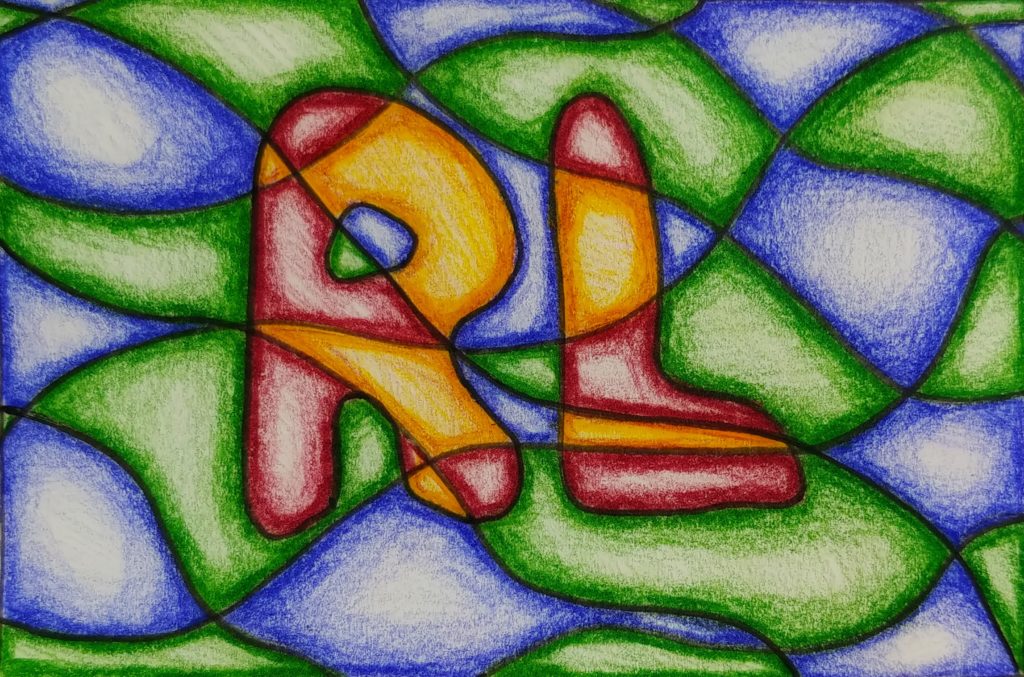
I drew the lines with a #2 pencil first, and then I darkened them with a hard-tip brush pen. For the colours, I used wax-based coloured pencils. My initials were warm coloured (red and orange), while the background was cool coloured (green and blue).
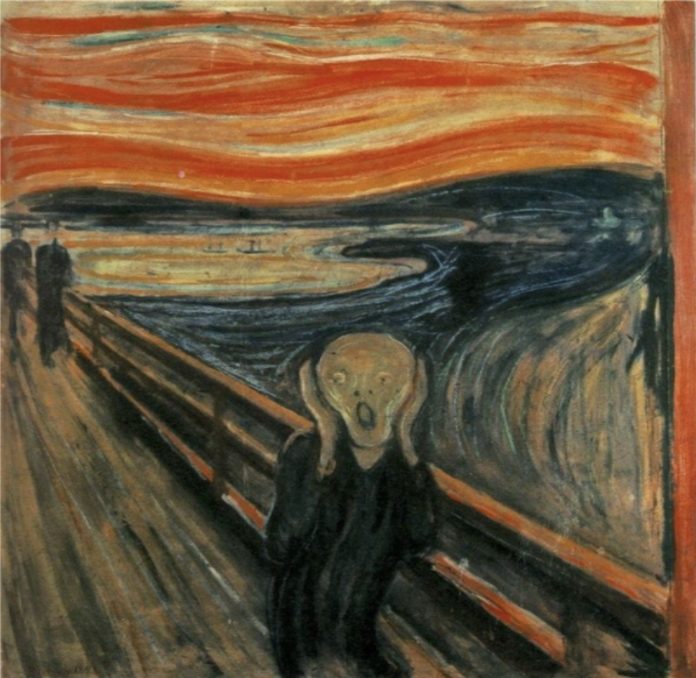
Artist Inspirations: Edvard Munch
Conduct an inquiry into Edvard Munch’s painting The Scream. Research the meaning of the painting and the colour theory behind Munch’s colour palette. Why do you think The Scream was met with such criticism when it was completed in 1893? What was it about the place, media, palette, and social and cultural contexts that affected this outcry?
“The Scream” by Edvard Munch shows an unknown figure against a turbulent sky. The vibrant oranges, yellows, and reds contrast with the pale blue-green of the centre figure, creating anxiety and turmoil. The distorted hands framing the hairless head convey genuine fear. When the painting was exhibited in Norway in 1895, it faced criticism due to its unconventional media (tempera and crayon on cardboard), eerie setting (a fjord overlooking Oslo), and societal context. Munch lived during a period of societal upheaval, marked by existential questions, anxiety, and changing norms. His personal experiences — loss of family members to tuberculosis, religious upbringing, and struggles with mental health — greatly influenced his art. In conclusion, Edvard Munch’s painting “The Scream” resonated with a society grappling with similar existential fears.
Sources:
– A Closer Look at the Scream by Edvard Munch – Draw Paint Academy
– The scream by Edvard Munch explained – Art Explora Academy
Stop and Think:
Why do art critics have different opinions according to time, place, media, and social and cultural contexts that they live in and are influenced by?
Art critics have different opinions due to several factors. Time: As years pass, artistic tastes change. What was admired in the past might not be appreciated today. Critics adjust their views to match the changes in the art world. Place: Where you are matters. Different cultures and histories shape how people perceive art. What is celebrated in one country might not be in another. Media: The way critics express their thoughts is also important. Whether they write for newspapers, TV, or online platforms, it influences their perspective. Social and Cultural Contexts: Critics are influenced by their surroundings. Their beliefs, values, and life experiences shape their interpretations of art. In conclusion, art criticism is influenced by varying factors that end up forming diverse ideas.
Sources:
– Exploring Art Criticism in the Current Media Landscape – Creative Flair
– Art criticism | Definition, History, Examples, Theories, Types, Importance, & Facts | Britannica