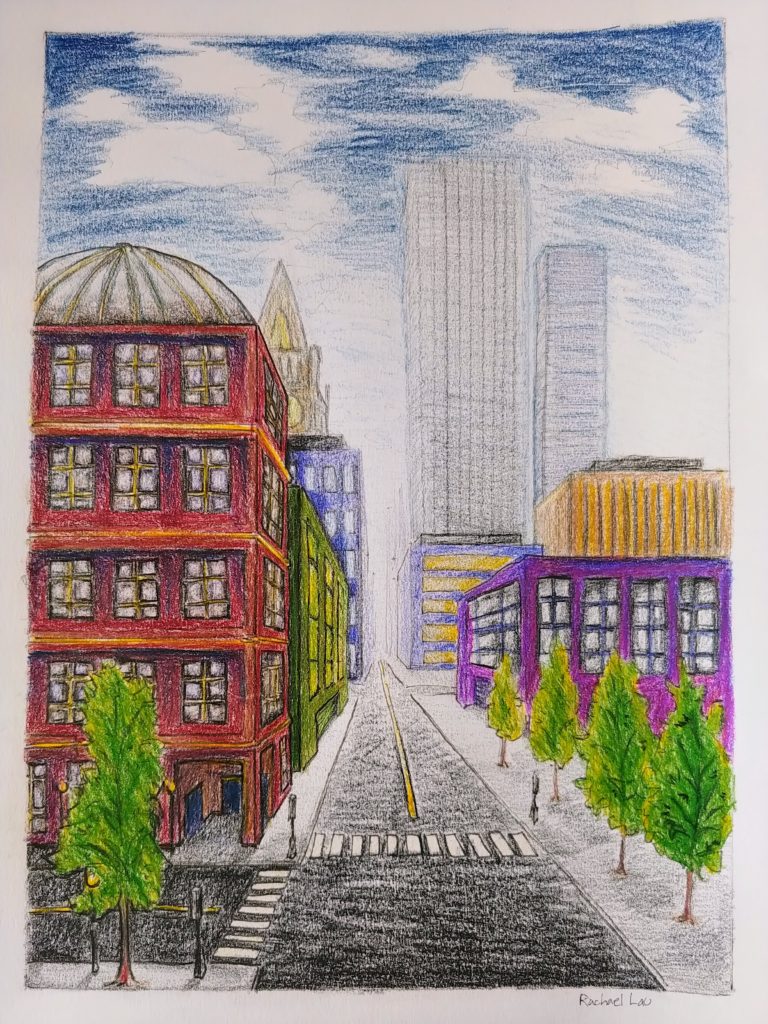
I first drew a perspective grid with graphite pencils and outlined the city with an ink pen. To help show depth and space, I used coloured pencils. The objects closer to the foreground are more vibrant and sharper than the objects closer to the background. Shading was also used for the darker areas and around the borders, which added a subtle vignette.
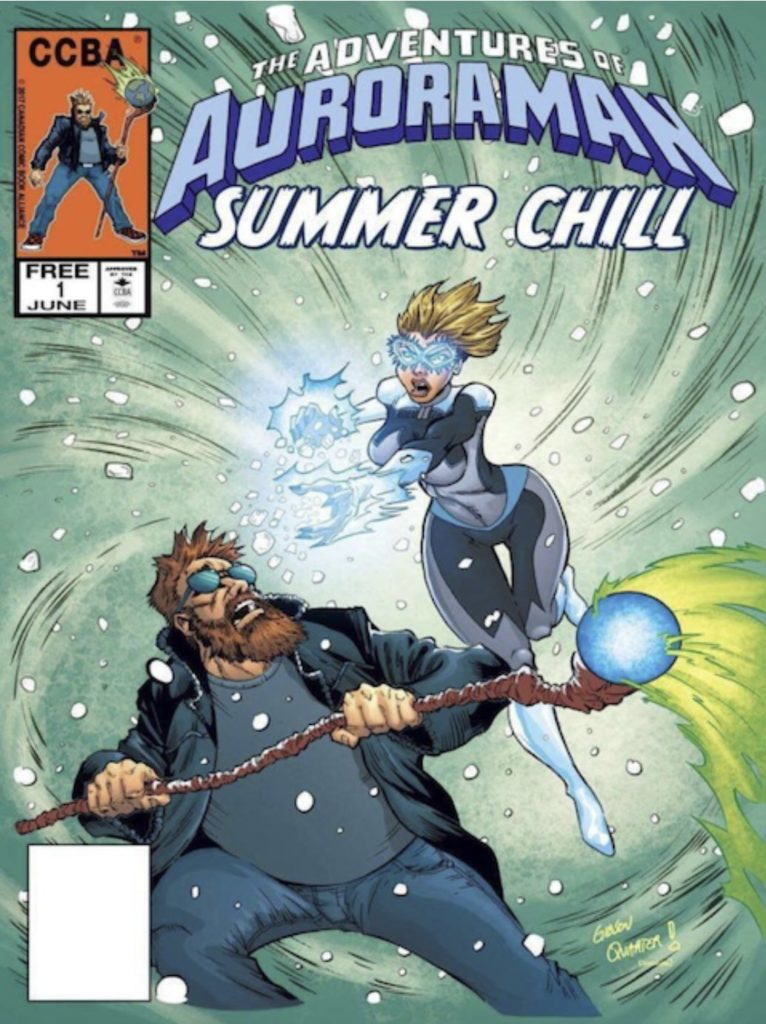
Artist Inspirations: Jeff Burton
How do you think Jeff Burton got his ideas for The Adventures of Auroraman? How does having the comic book series set in Humboldt, Saskatchewan, affect the story? Conduct research into potential careers in visual art as they relate to comic book publishing.
Jeff Burton got his ideas for The Adventures of Auroraman from various sources. For example, his inspirations came from other creators like Jason Loo (Pitiful Human Lizard), Donovan Yaciuk (Spacepig Hamadeus), and James Zintel (Shump), as well as mainstream works like Peter David’s Multiple Man/X-Factor and James Robinson’s Starman. Having the comic book series set in Humboldt, Saskatchewan, brought authenticity and a sense of place to the overall story. The community spirit, landmarks, and culture of Humboldt play a role in shaping the adventures. As a teacher, Burton also gets his creativity from the young minds of his students and gathers the ideas to create new stories. According to research, careers related to comic book publishing include comic book writer, illustrator, colorist, letterer, or editor. In conclusion, Jeff Burton gathers inspiration from his everyday life, which in turn, helps others like me to find inspiration from the simplest of things.
Sources:
– Indie Interviews – Auroraman (comicbasics.com)
– Sask. teacher becomes superhero, Auroraman | CBC News
– Saskatchewan comic book’s ‘Auroraman’ conquers evil with podcast | Globalnews.ca
Stop and Think:
In what ways should our individual and cultural identities be expressed visually? How is this conveyed by Saskatchewan artists?
Our individual and cultural identities can be expressed through various forms of visual art. That includes painting, sculpture, literature, and performance. These art forms allow us to explore the connection between personal identity and cultural aspects, as well as express our unique experiences and emotions. As for Saskatchewan artists, they convey their individual and cultural identities through a diverse range of artistic forms. Traditional Indigenous arts, such as rock art and ceremonial items, continue to inspire contemporary interpretations. These artists incorporate Indigenous designs into modern clothing and accessories, celebrating their heritage. Additionally, Indigenous art serves as a powerful expression of cultural identity, bridging the past and present. Notably, Chantel Yuzicappi contributes to this art by infusing her works with personal stories and cultural significance at Saskatchewan Polytechnic.
Sources:
– Artists’ Exploration of Personal and Cultural Identity in Their Art (fine-artist.net)
– Indigenous Artists and Cultural Identity in Canada – BIGGLE Souvenirs & Gift Shop
– Treaty 4 artist adding to Indigenous visual identity at Saskatchewan Polytechnic (saskpolytech.ca)