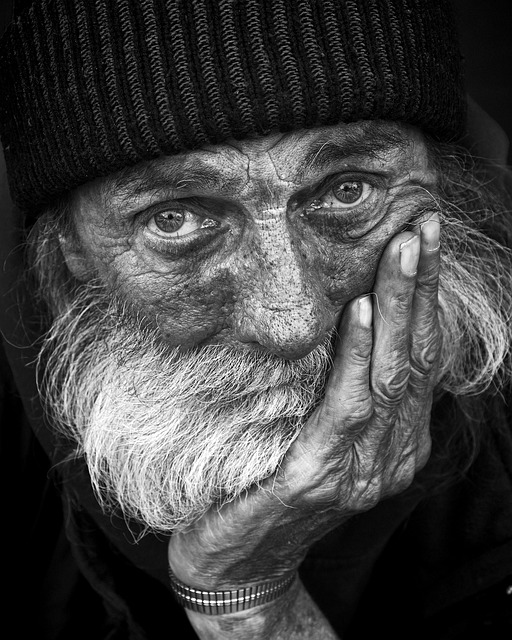
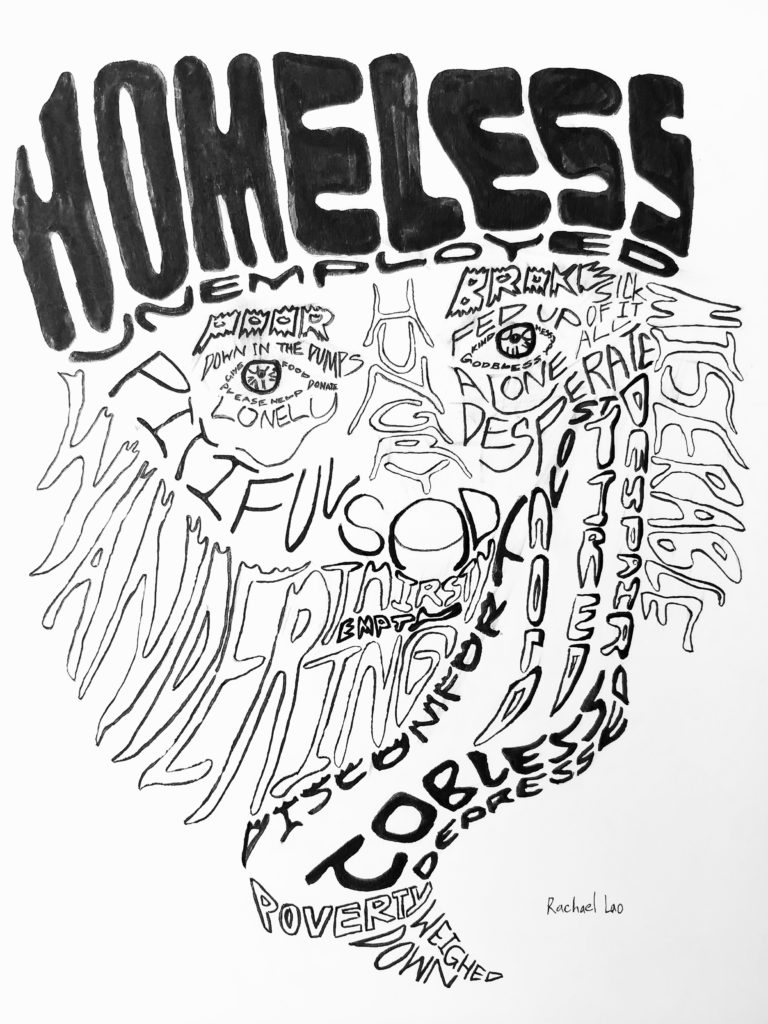
This is a drawing of a homeless man. It was my first time doing this, so it was a bit challenging. I chose words that were related to homelessness and the associated feelings that people might experience. Then, I arranged them in a way that flowed with the contours of the portrait.
As for the emotional subject matter of my drawing, it is an issue that I feel strongly about in my community. Poverty affects many of the people and can lead to major consequences. Because of that, I sometimes see people who are stealing, doing drugs, and homeless. I feel pity for them and what they go through to survive.
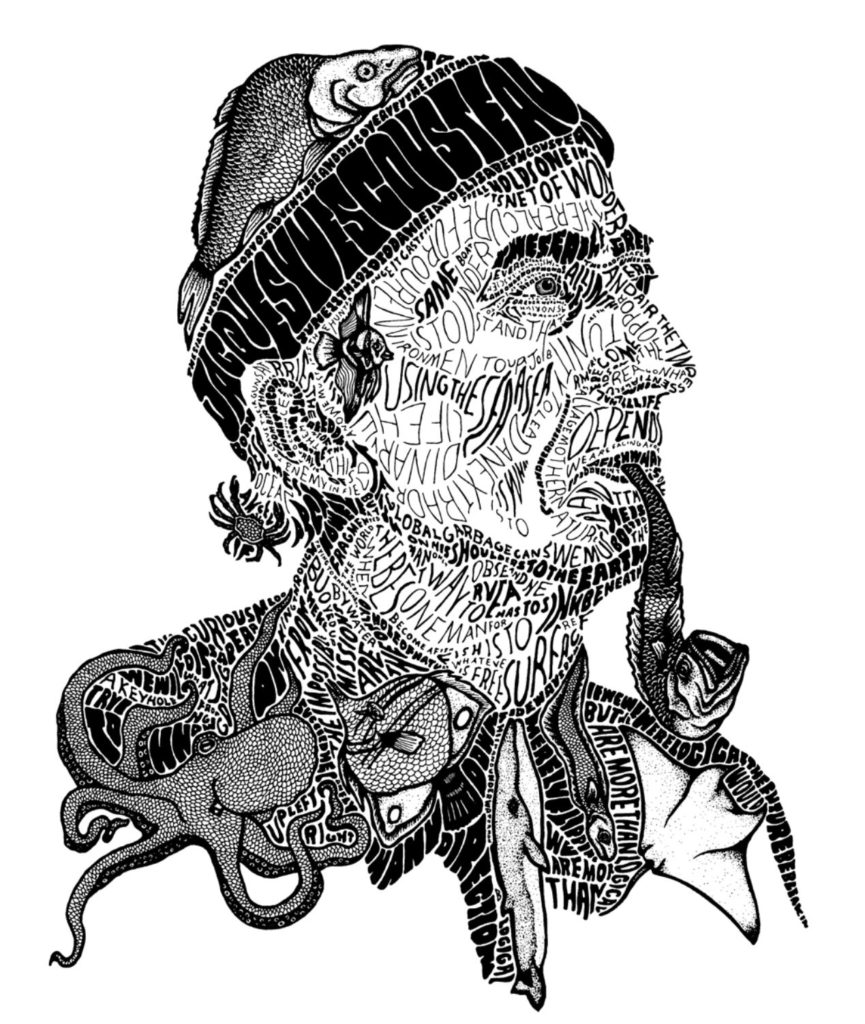
Artist Inspirations: Sarah King
Look closely at Sarah King’s typographic portrait, Jacques Cousteau. Could you tell who the subject is by reading the text? What else can you find out about the man just by looking at the portrait? What principles of design did Sarah King use in this typographic portrait?
Taking inspiration from Sarah King’s journey as a visual artist, conduct some research and generate a list: what career opportunities related to the visual arts are of interest to you?
Sarah King’s artistic portrait of Jacques Cousteau uses intricate typography to create an image of the famous marine explorer and conservationist. His name is boldly written on the beanie’s brim. The composition balances text and negative space, making it easy to identify certain parts of the portrait just by looking at it. It mostly shows Cousteau’s legacy and his connection to the underwater world. The principles of design that Sarah King used in this portrait were, balance, contrast, unity, and typography.
Inspired by Sarah’s journey, career opportunities related to the visual arts include illustration, graphic design, animation, photography, visual effects, interior design, architecture, and art education. I find each path interesting because they allow for unique expression and creativity.
Sources:
– Artist Profile: Sarah King Could Be Whistler’s Most Wide-Reaching Artist – Mountain Life (mountainlifemedia.ca)
– Jacques Cousteau | Biography, Inventions, Books, & Facts | Britannica
– Careers in Visual Art and Where You Can Work (With Skills) | Indeed.com Canada
Stop and Think:
Why are appropriation and intellectual property rights issues for artists? What is the difference between copying as a learning exercise versus representing other ideas as one’s own?
As an artist, how can you become more conscious when searching for inspiration so you don’t appropriate others’ ideas or imagery?
In the world of art, appropriation means borrowing ideas or elements from existing works to create new works. On the other hand, intellectual property rights are like rules that protect artists’ creations. When borrowing other people’s ideas or imagery, it is important to know these rules. If copying is used as a learning exercise, that is okay. However, if it is used to steal their creations and claim as one’s own, that is not okay. As an artist, it is important for me to be mindful when seeking inspiration and give credit where it is due. I can do this by doing research, acknowledging sources, and respecting other artists’ work.
Source: Appropriation – Electronic Art + Design (uci.edu)